Your shopping cart is currently empty.
| Subtotal | €0,00 |
| Shipping costs | including VAT, excl. Shipping costs |
| Total | €0,00 |
|---|


09.09.2026
Table of Contents
- What exactly is worm compost?
- Why do people make their own worm compost?
- Is a worm farm even worth it?
- How does a worm farm work?
- The three biggest challenges
- How much worm compost is actually produced?
- What about the "worm tea" from the worm farm?
- Who would benefit from doing it themselves?
- When is purchased worm compost more useful?
- Conclusion: Should you make your own worm compost or buy it?
Worm compost is a nutrient-rich organic fertilizer and soil improver. It improves soil structure, promotes soil life, and provides plants with essential nutrients. It's no wonder, then, that many gardening enthusiasts are considering making their own worm compost.
But is having your own worm farm really worth it? How complicated is it to make? And how much worm compost do you actually end up with?
This article explains how a worm farm works, what challenges you will face, and for whom it is really worth making one yourself.
What exactly is worm compost?
Worm compost It is produced when composting worms, together with microorganisms, decompose and transform organic material. This process creates a fine-crumbly, humus-rich material, also known as worm castings.
Worm compost contains nutrients, organic compounds, and a diverse community of microorganisms. Its exact composition depends, among other things, on the starting materials used and the conditions during composting. Therefore, it is frequently used as a premium fertilizer for gardens, raised beds, and trees.
Why do people make their own worm compost?
Having your own worm farm has many advantages: Kitchen scraps are put to good use and don't end up in the trash. At the same time, you get high-quality fertilizer for plants and garden beds. Other advantages include:
- less organic waste
- own fertilizer
- Promoting sustainable gardening
- exciting nature project for adults and children
- better insight into the processes of soil life
Is a worm farm even worth it?
Before you set up a worm farm, you should ask yourself one important question: Do you mainly want to produce fertilizer, or are you interested in the system as a hobby?
A worm farm isn't simply a box into which you throw kitchen scraps. The worms need suitable conditions and regular care. Anyone who enjoys natural processes and likes to experiment will often find a worm farm very rewarding.
However, those who need larger quantities of worm compost for the garden or several trees as quickly as possible will quickly reach practical limits.
How does a worm farm work?
The basic principle is simple: The worms are fed organic material. This is decomposed by them and the accompanying microorganisms. Gradually, this process produces high-quality worm compost. The following factors are important:
The right home
Worm farms can be operated in special worm composters, wooden boxes, or plastic containers. Important points to remember are:
- adequate ventilation
- good water drainage
- Protection from extreme temperatures
- enough space for the worms
The right worms
Compost worms are primarily used for worm farms, such as... eisenia fetida and Eisenia andrei They are used. They naturally live in substrates very rich in organic matter and are therefore particularly well suited for vermicomposting.
The right food
Examples of suitable examples are:
- Vegetable and plant scraps
- Fruit bowls in moderate quantities
- Coffee grounds and coffee filter
- tea residue
- shredded uncoated cardboard and paper
- smaller amounts of leaves
are not suitable or only suitable to a limited extent:
- meat and fish
- Dairy Products
- Heavily salted or spiced leftover food
- very fatty foods
- larger quantities of citrus fruits
- coated or heavily printed paper
The three biggest challenges
1. The right moisture
Compost worms need a moist environment. If the worm farm is too dry, the worms' activity slows down. If it's too wet, oxygen deprivation, rot, and unpleasant odors develop. Finding the right balance is one of the most important tasks.
2. The right temperature
Compost worms thrive at temperatures between approximately 15 and 25 degrees Celsius. Strong heat and frost should be avoided, as extreme temperatures can harm the worms.
3. patience
It can take several months before a newly established worm farm yields larger quantities of mature worm compost. The rate at which the material decomposes depends on factors such as temperature, worm population, feeding, and moisture.
How much worm compost is actually produced?
How much worm compost a worm farm produces depends heavily on its size, the number of worms, and the amount of available organic waste. Smaller quantities may suffice for houseplants and potted plants. However, those wishing to manage larger garden areas, raised beds, or multiple trees will need correspondingly more material.
What about the "worm tea" from the worm farm?
In some worm farms, a liquid collects at the bottom, often referred to colloquially as worm tea. However, this is usually leachate from the composter. It is not the same as intentionally produced worm compost extract or compost tea. This liquid should not be confused with genuine worm compost extract and should only be used with caution as plant fertilizer.
The composition of worm tea depends heavily on the conditions in the worm farm. A large amount of leachate can also indicate that the substrate is too moist.
Who would benefit from doing it themselves?
A worm farm is particularly interesting for people who:
- I would like to live sustainably
- want to recycle kitchen waste
- Enjoying biological processes
- smaller amounts of fertilizer are needed
- looking for a new gardening hobby
In these cases, a worm farm can be very beneficial.
When is purchased worm compost more useful?
Not everyone has the time or space for their own worm farm. Those who want to easily supply plants or trees with a product based on worm compost can therefore also use ready-made products.
One option is liquid fertilizer based on worm compost. It's easy to dose and apply directly with the watering can. Here you can find, for example, the... Baumbad liquid fertilizer based on worm compost buy.
Conclusion: Should you make your own worm compost or buy it?
A home worm farm is an exciting way to transform kitchen scraps into valuable fertilizer. It provides insights into the fascinating world of soil life and supports sustainable gardening.
Those who primarily want to care for their plants or trees in a straightforward manner can use ready-made worm compost or products based on worm compost. Making it themselves requires time, space, and regular maintenance.
For many hobby gardeners, a combination of methods makes sense: A home worm farm provides valuable experience and smaller quantities of worm castings. For larger projects or the care of trees, high-quality, fully mature worm compost can be a practical supplement.
Natural fertilization and activation of soil life
The power of the soil

Offer -35%
Baumbad liquid fertilizer made from worm compost, 3 liters - NPK 1-1-1
liquid fertilizer
€24,99 €38,97

Offer -23%
Baumbad Liquid Fertilizer Vermicompost 1 Liter / Worm Compost Tree Fertilizer NPK 1-1-1
liquid fertilizer
€9,99 €12,99

Offer -11%
Baumbad Premium Liquid Fertilizer made from worm compost, 5 liters - NPK 1-1-1
liquid fertilizer
€39,99 €44,99

Offer -29%
Baumbad Liquid Fertilizer - Vital Bath - Regeneration for Damaged Trees 5 Liter
liquid fertilizer
€39,99 €56,49

Offer -34%
Baumbad Liquid Fertilizer - Vital Bath - Regeneration for Damaged Trees 3 Liter
liquid fertilizer
€24,99 €37,99

Offer -25%
Baumbad Liquid Fertilizer - Vital Bath - Regeneration for Damaged Trees 1 Liter
liquid fertilizer
€9,99 €13,49
Tips, knowledge and practical advice for strong trees
Discover more posts
Trees need nutrients to grow healthily. In many gardens or cities, these nutrients are lacking in the soil, for example, because leaves are removed or the soil is heavily used. Appropriate fertilization can help improve the soil and support tree growth. However, it's important not to fertilize simply "on a hunch," as some soils already contain sufficient nutrients.
Organic fertilizers like compost or worm castings work more slowly, but improve the soil in the long term and promote soil life. Mineral fertilizers work faster, but usually only provide individual nutrients. For many trees, organic fertilization is the more sustainable solution in the long run.
Yes, that can be very helpful. A soil sample can determine which nutrients are present in the soil and which are lacking. The pH value is also measured. This allows you to fertilize the tree precisely and avoid over-fertilizing. A simple soil analysis usually only costs around [price missing]. €20–40.
A nutrient deficiency can manifest itself, for example, through yellow or pale leaves, weak growth or few flowers show. However, similar symptoms can also be caused by drought or compacted soil These problems arise. Therefore, you should always check first whether the tree is getting enough water.
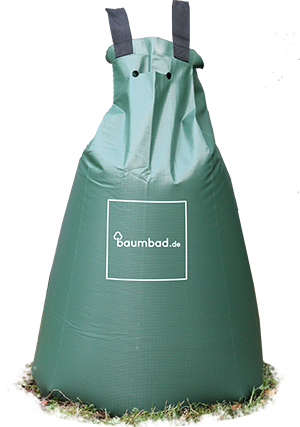
Yes, that's possible. Irrigation bags release water slowly into the soil. When liquid fertilizer is mixed with water, it reaches the root zone evenly. This way, a large portion of the soil around the tree comes into contact with the nutrient solution.
The best time to fertilize is usually in spring and early summerFertilizing is best when the tree is growing and producing new leaves. During this phase, the tree can absorb nutrients particularly well. Very late fertilization in autumn is usually not advisable.
The soil is home to many microorganisms, such as bacteria, fungi, and earthworms. They break down organic matter and make nutrients available to plants. Active soil life therefore helps trees absorb water and nutrients more effectively. Organic fertilizers can support this soil life.
Great idea, easy handling and everything from ordering to delivery.
Michael K.